



The global quest for sustainable energy solutions and environmental
protection has accelerated the exploration of advanced materials—
especially at the nanoscale. Nanostructured materials have emerged as
transformative enablers in clean energy conversion, efficient energy
storage, and environmental remediation technologies. Their exceptional
physicochemical properties—including high surface area, tunable
electronic structure, enhanced reactivity, and selective functionality—
make them indispensable in addressing some of the most pressing
challenges of the 21st century: climate change, energy scarcity,
environmental pollution, and resource optimization.
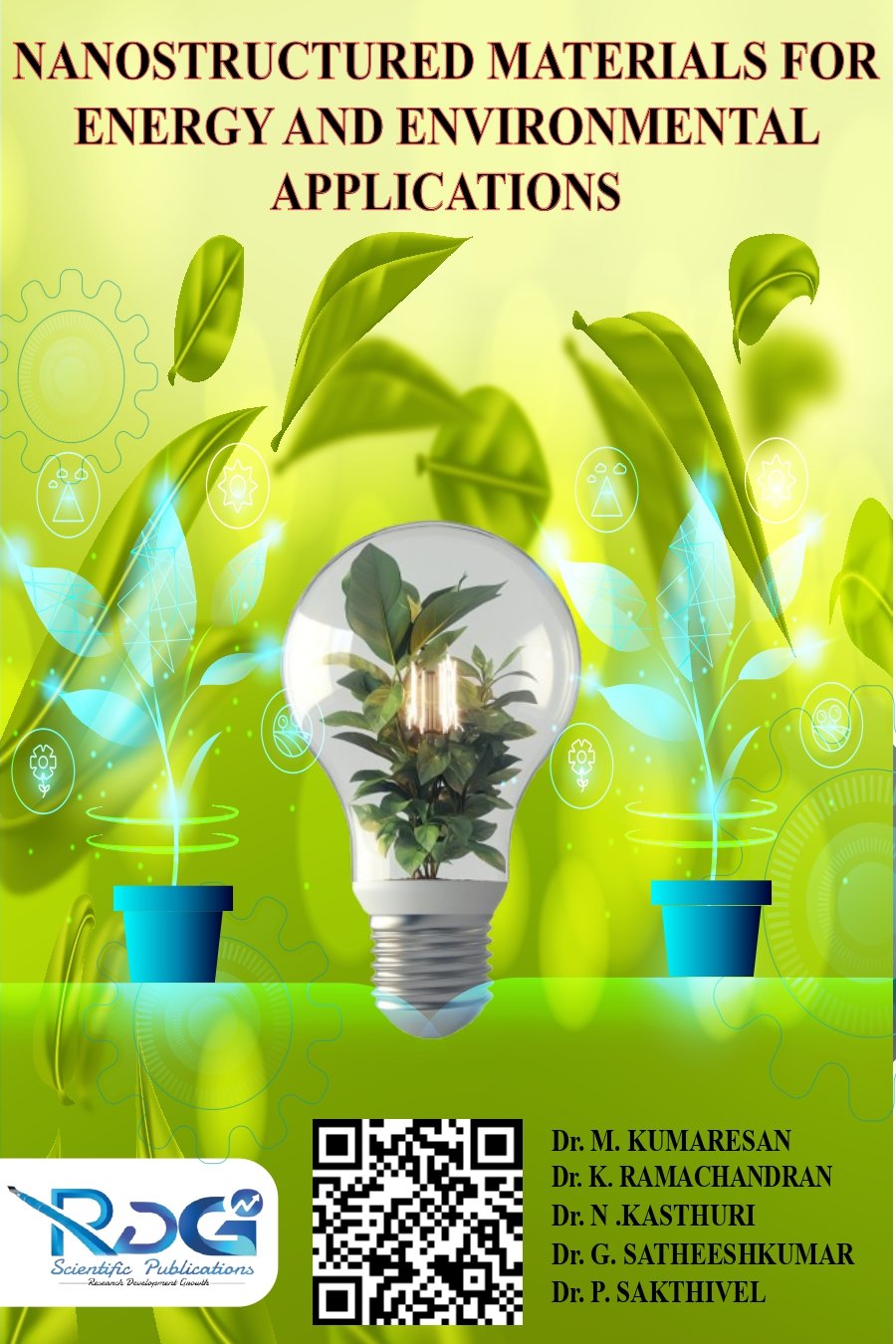
This book, Nanostructured Materials for Energy and Environmental
Applications, is designed to provide a comprehensive and application-
oriented overview of the science, engineering, and technology behind
nanomaterials. It bridges fundamental concepts with real-world
applications, combining theoretical understanding with modern
technological advancements. The content is structured to support
students, researchers, academicians, industry professionals, and policy-
makers seeking scientific insight into the potential of nanoscale
innovations.
The introductory chapter offers a strong foundation by exploring the
fundamentals of nanoscience and nanotechnology, classification
schemes, synthesis routes, comparison with conventional materials, and
real-time industrial applications. Understanding how nanomaterials
differ from their bulk counterparts is key to appreciating their potential
in modern engineering.
Chapters 2 and 3 delve into the heart of energy applications. They
present a holistic view of global energy conversion technologies,
semiconductors for photocatalysis, photovoltaic nanostructures,
plasmonic systems, thermoelectric materials, photoelectrochemical
hydrogen production, and the emerging role of artificial photosynthesis.
The sections on lithium-ion batteries, supercapacitors, metal–air
systems, hybrid storage technologies, and wearable energy devices
illustrate the power of nanomaterials in shaping the next generation of
energy storage systems.
Environmental sustainability is another cornerstone of this book.
Chapter 4 explores how nanostructured materials are revolutionizing the
remediation of air, soil, and water pollutants. Mechanistic insights into
adsorption, advanced filtration, photocatalytic degradation, catalytic
oxidation, and nano-sensing technologies are provided alongside real-
world case studies and current innovations in environmental cleanup.
The fifth and final chapter elevates the discourse by focusing on
safety, sustainability, ethics, policy, regulations, and futuristic
perspectives. Topics such as green nanotechnology, life-cycle
assessment, AI-driven material design, circular economy integration,
global standards, social acceptance, and Sustainable Development
Goals (SDGs) help the reader understand the broader implications of
nanotechnology in society and governance. Emerging trends—
including quantum materials, bio-inspired nanostructures, 2D
heterostructures, and machine learning—highlight the
interdisciplinarity and rapidly evolving nature of this field.
We hope this work serves as a valuable reference and catalyst for
research, education, and innovation in the domains of energy and
environmental sciences. May it empower the next generation of
thinkers, engineers, and innovators to shape a sustainable world through
the intelligent use of nanotechnology.











Reviews
There are no reviews yet.