

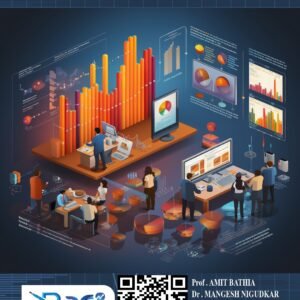
The financial world is undergoing a profound transformation, driven by
unprecedented volumes of data, complex global interconnections, and
rapid technological innovation. Traditional approaches to risk
management—once rooted in statistical models, historical trends, and
regulatory frameworks—are increasingly challenged by the dynamic,
uncertain, and often volatile environment in which financial institutions
operate today.
Artificial Intelligence (AI) has emerged as both a disruptor and an
enabler in this landscape. Its ability to process massive datasets, detect
subtle patterns, adapt to changing conditions, and deliver real-time
insights is redefining how financial risks are identified, measured, and
mitigated. From predictive modeling and anomaly detection to natural
language processing and generative intelligence, AI offers powerful
tools to strengthen resilience against market shocks, credit defaults,
cyber threats, and operational failures.
This book, Artificial Intelligence for Financial Risk Management and
Analysis, aims to provide a comprehensive understanding of how AI
technologies are reshaping the discipline of risk management. It brings
together the theoretical foundations of AI, practical applications in
financial contexts, and the critical discussions surrounding governance,
ethics, and regulation. Each chapter builds progressively—from core
models and techniques, through real-world applications, to the
infrastructure and governance frameworks needed to sustain responsible
AI deployment in financial institutions.
Our intent is twofold: first, to serve as a guide for practitioners, risk
professionals, data scientists, and policymakers seeking to harness AI
for robust financial risk management; and second, to offer a roadmap
for researchers and students eager to explore the frontier where finance,
technology, and ethics intersect. By integrating technical depth with
industry case studies and forward-looking trends, this book aspires to
bridge the gap between theory and practice.
As AI continues to evolve, so too must our approaches to risk
management. This work does not claim to provide final answers but
rather to equip readers with the knowledge, frameworks, and critical
perspective needed to navigate a future where human expertise and
artificial intelligence must work hand in hand.













Reviews
There are no reviews yet.